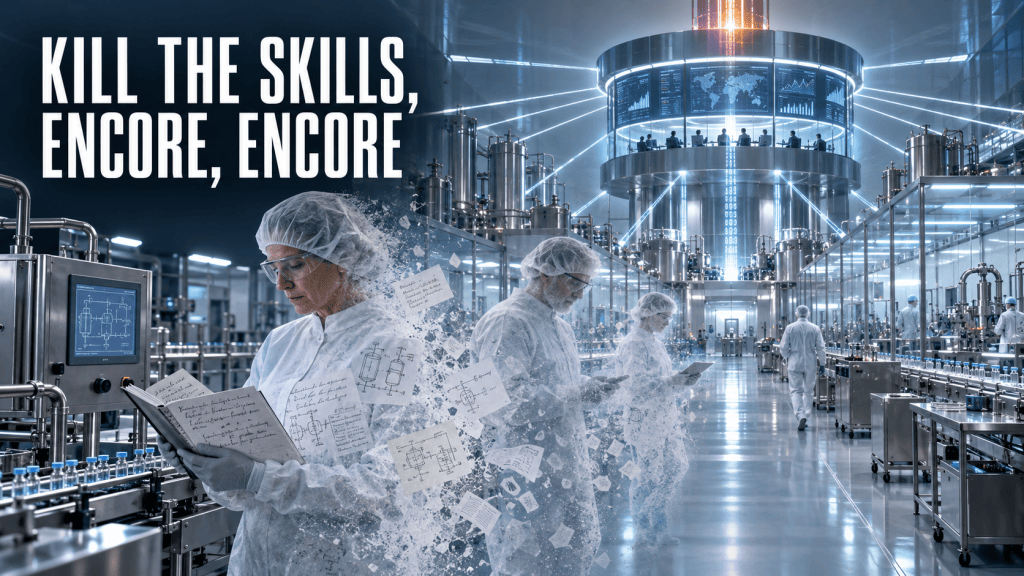
It’s a funny image. It also says something about the difficulty, today, of persuading some industrial organizations to reconnect with the shop floor.

In large companies, Supply Chain planning decisions are becoming increasingly centralized. They are now often made far from the factories, using screens, dashboards and data that provide a useful—but necessarily partial—view of reality.
Yet a factory cannot be reduced to a screen.
There are the machines, their limitations and the unexpected problems that arise. There are the teams, their expertise, quality and safety requirements, and last-minute changes. Above all, there are the conversations that help us understand what is really happening and find a workable solution together.
I have always believed that you cannot build a lasting partnership between planning, production, a factory, a subcontractor and its industrial teams while staying far from the shop floor. You can give instructions and track performance indicators remotely. But to understand constraints, anticipate difficulties and build trust, you have to be there in person.
I also wonder whether this distance from the shop floor is partly linked to how our habits have changed from one generation to the next. With a touch of provocation, I call it the shift from the Game Boy and PlayStation generation to the TikTok generation: generations that grew up with the idea that much of life happens—and can be understood—through a screen.
Of course, not all young people are like this, and screens are not the problem in themselves. But when digital tools become our main point of contact with work, we can end up believing that a dashboard is enough to understand a factory. Yet no data can fully replace what we learn by observing a production line, talking with the teams and understanding their real-world constraints.
Digital tools are essential. They help us share information, model scenarios and coordinate our activities more effectively. But they cannot replace meeting production teams, talking beside a production line or gaining a practical understanding of the trade-offs involved.
So how can we persuade those who are used to making decisions remotely to spend time on the shop floor regularly?
That is where the challenge begins. It is not about organizing a symbolic visit a few times a year. It is about making time on the factory floor a normal part of the job: listening, observing, asking questions and testing plans against reality.
The goal is not to make decisions for the teams. It is to work with them to find the best possible solutions: producing under the right conditions, making the best use of equipment and meeting customer needs.
Teaching a cat to swim seems almost impossible. But perhaps the real challenge is first to make it want to come near the water—and to show that we can only truly understand a factory if we take the time to step inside.
How much of a role does the shop floor play in your industrial decisions?
Emmanuel de Ryckel